

What Could Someone You Never Heard of Teach You? 6/25/26
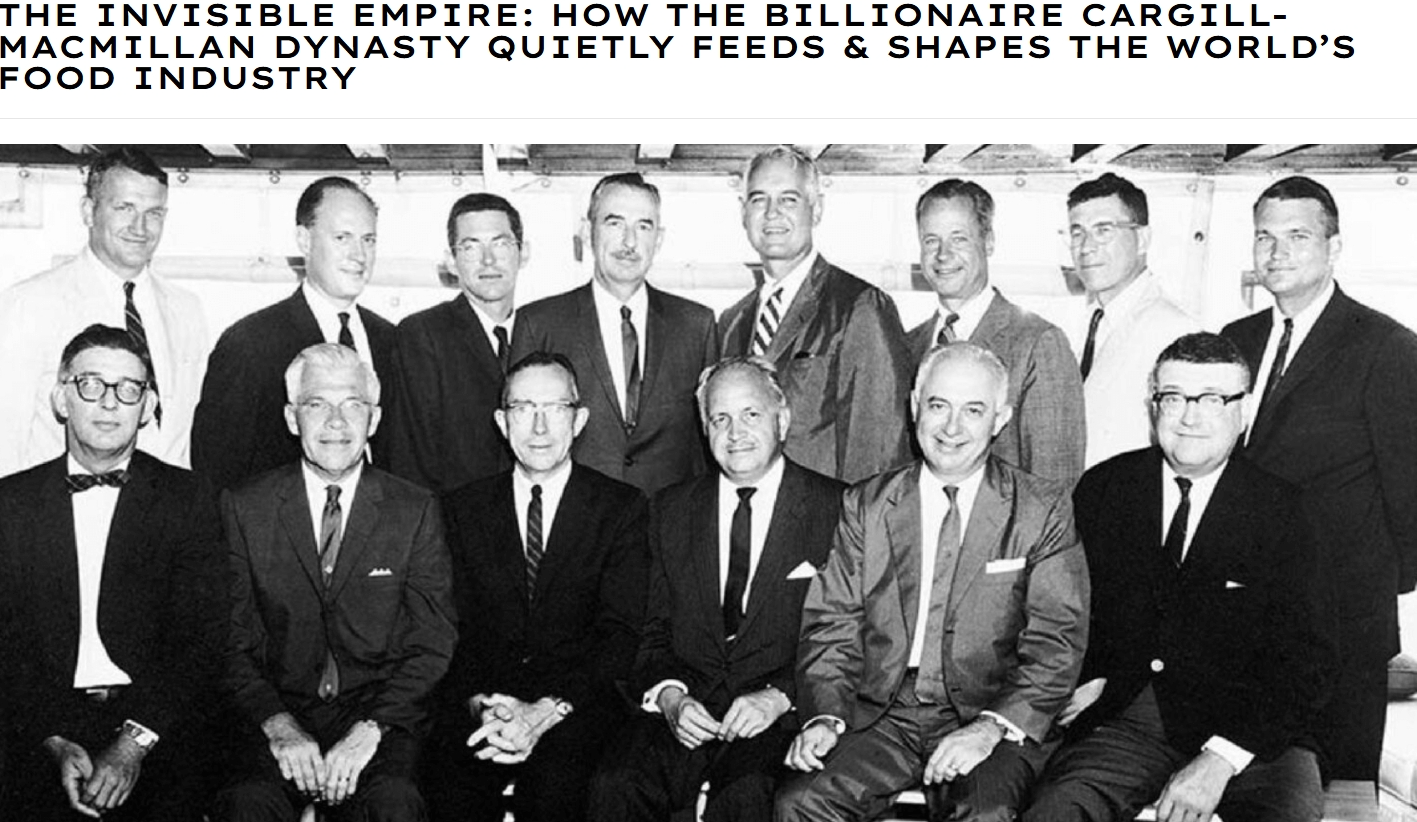
What if you could talk to a family with a family business that has been in business 160 years, is in its sixth generation, is the largest privately owned business in the United States, every day you consume something they produce, and you likely have never heard of them. What if they invited you to dinner. What questions would you like to ask them?
“William Wallace Cargill founded Cargill Inc. in 1865, at the end of the U.S. civil war. He owned a single grain storage warehouse at the end of a lonely rail line in Conover, Iowa. The MacMillan family joined the ranks in 1895 when W.W.’s daughter, Edna, married John MacMillan, who took over the company when W.W. died. Later, when MacMillan inherited the company in 1912, the company was over-leveraged. It was also facing a failed investment in a Montana irrigation project that had left Cargill’s financials in dire straits. To keep the company afloat and bankers confident, MacMillan restructured the company. He renegotiated loans, extended debt payments, and sold off less profitable parts of the company. One particular move by MacMillan had a lasting impact – a change to Cargill’s leadership structure. The MacMillan in-laws were given controlling shares in the company, while the Cargill family members became minority shareholders. Within six years, Cargill had paid off all of its debt and was growing again.”[i]
Revenues for their multiple companies in recent years have been in the $160 billion range. Today 100 family members now in their sixth generation own about 90% of the family’s companies with the remaining 10% owned by key management, which is all non-family, and employees.
“Whitney MacMillan was the last family member to run Cargill. He retired in 1995, and every chief executive since has come from outside the family; the current one is the tenth in the company’s history. Beginning in the 1970s, the family added independent directors to the board. The family did not walk away. The two branches still hold board seats and govern as owners. They simply stopped assuming that the right person to run a global commodities business would always be born into it. The distinction matters because the alternative is both familiar and expensive: an heir installed in the operating seat for reasons of lineage rather than fit, then judged by a market that does not care about the family tree. Family control over direction and family control over daily operations are two different things. Cargill kept the first and let go of the second on purpose.”[ii]
“Build the exit ramp before anyone needs it: Everyone exits a business eventually. Waiting until the last minute will usually be a disaster. See Liquidity Planning below.
“Harmony between the Cargills and MacMillans has, at times, been a challenge, despite the company’s success. Like many family-controlled enterprises, there have been occasional disputes and tension over influence in the company. Some Cargills believe that their family business was “stolen” from them, while some MacMillans have felt that their work in “saving” the business has gone unnoticed and unappreciated. But these conflicts have also highlighted the need for the families to come together with a shared vision for the growth and success of Cargill Inc. So they formed Waycrosse, a family office that serves the interests of the families. Originally designed to only provide financial and professional advice, today Waycrosse also organizes training and education programs for the three living generations. It also actively works to ensure family members not working in the company are engaged with the business – through education programs, meetings, plant tours, and task forces.”[iii]
“The lesson is plain. A family that intends to stay private must give its members a way out that is not an initial public offering, and it must build that mechanism before a death, a divorce, or a disagreement turns one person’s need into everyone’s crisis. The release valve has to exist, and survive a stress test, before the pressure does.” (Emphasis is mine)
Next-generation legitimacy is earned, not assumed: As mentioned, the CEO for many years has been a non-family person and the majority of the board of directors is composed of non-family people. One reason for this is to avoid favoritism towards family members. While there is no prohibition for a family member to work in the company, they must compete with their peers in the marketplace and would be compensated at market rates for their specific positions. (See Next-Gen Education and Exposure below)
Hopefully, during dinner you were taking notes that include some of the following highlights while the 4th, 5th, and 6th generations of Cargill and MacMillan families shared their history, their business, family issues and conflicts, and their family values:
- Governance is critical: They have a 17-member board of directors of which 6 are family members and the rest non-family members. The outside-the-family directors provide a range of business experience and wisdom and objectivity to do what is best for the business rather than the individual family members, while keeping the family members informed and benefiting all family owners in the long run. Having the right advisors is critical!
- Creating the family office: Had they utilized traditional estate planning of passing ownership to the next generation with everyone receiving an equal share, the company would have disappeared by the third generation because individual desires would have taken precedent over building the company and drained cash or required liquidating assets to make those distributions thus eliminating the cash to grow the business. By creating the family office, the business remains an investment that continues to grow to benefit everyone rather than cutting it into pieces.
- Reinvesting dividends to grow the asset: An ongoing value in their success is elevating the health of the business over providing current income to the family stockholders. Their principle since 1912 after overcoming their heavy debt is to reinvest 80% of the profits back into the business and distribute 20% in dividends to the stockholders. This allowed them to expand into more products and increase sales revenues and everyone’s net worth.
- Separated CEO and Chairman roles: Reduced concentration of power made governance stronger.
- Family office assemblies: The family council meets regularly to keep family informed and united and to encourage communication to prevent misunderstandings.
- Professional CEOs: Using non-family people eliminates power struggles. Hiring professionals who have wide business and international experience allows the family to have the best and brightest leaders grow and expand the business. That is not to say a family member cannot be the CEO or hold any office in the business. Many family businesses have family members in key positions. The point is they should be in those positions because they are qualified and the best person to be in that position, not just because they are family members.
- Employing family members: While there may not be a prohibition to hiring family members, a family member seeking employment within the family business or family office is treated as a non-family member that must meet the criteria and experience of a like candidate. If the candidate is the better choice, he or she would get the position.
- Next-Gen education and exposure: Family members must earn MBAs or similar degrees no matter if they are not in the business. Next-gens are required to tour all the facilities and learn the basic operations of the entities so they have a good understanding of what they own to foster appreciation and be good stewards of what they own. They are kept informed through family meetings and regular communication. “Ownership at Cargill has not conferred automatic standing. The family has leaned on education requirements and direct operational exposure so that the people who own the company understand what they own. (my emphasis) This is unglamorous work, and it is precisely the work that keeps a hundred shareholders from voting on an asset they do not understand. An owner who has never seen the scale of the operation, never sat with its risks, and never been taught why the reinvestment rule exists is an owner who will eventually ask why the dividend is so small. Education is how you keep that question from becoming a movement.”[iv]
- Liquidity planning: They anticipated some family members may want to give up their ownership for cash, so they ensured there would be sufficient cash to buy out a family member when the time came. “The most instructive move came in 1992. A faction of the family wanted liquidity, and the pressure to take the company public was real. Instead of listing, Cargill used its own balance sheet to let family shareholders tender about seventeen percent of the stock for roughly seven hundred million dollars, placing those shares in an employee stock ownership plan. The restless owners got cash. The company stayed private. Years later, when the death of a major shareholder created a second liquidity problem, the family again engineered a private path rather than a forced sale.”[v]
- Attention, Intention and starting early: From their beginning, the family leaders paid attention to the details of not only running a business, but also what was necessary to keep the business in the family. Their intention was always to transition the business and the wealth to the next generations in ways that would improve each generation and strengthen family relationships rather than creating division. They started this in 1992.
- Commitment: It should be obvious that their success happened because the team and entire family were and are committed to the goals and objectives that kept this business in the family rather than taking it public.
- Honesty, Communication, and Care: They were honest with themselves in that they acknowledged their business and wealth would create conflicts and relational challenges in the family and they cared deeply about each individual and the entire Cargill and MacMillan families. Their Next-Gen Education and Exposure mentioned above would keep everyone involved in the family businesses even though they would not be an employee. Their principle of reinvesting 80% and distributing 20% was based on understanding everyone’s net worth would grow much greater by having their individual ownership in a growing business rather than exposing large dividend payments to wanton spending, divorces, and poor investments.
Well, dinner is over and it is time to go home. While this discussion was about a family with a business, the principles discussed above apply to every family, no matter the size of the wealth, even if they do not own a business. Will anyone know about your family by the time your third generation are adults? Will the business still exist? The Cargill and MacMillan families chose to fly under the radar. Most families and family businesses vanish from the radar because the family dissolves and disappears when the next generations have not acquired the experience and skills to properly manage the wealth and the family relationships. Will your wealth affect the next generation positively or negatively? The difference is Attention, Intention, Commitment, Honesty, Communication, Care, and starting now. It is new day! Let us help you be the next family that can share with other families how your family made it to the 3rd generation. Or even the 6th generation!
[i] Inside the Cargill Family by Sarah Reid, July 10, 2019, Inside the Cargill Family — Sarah Reid
[ii] How the Cargill Family Held a Fortune Together for 160 Years: Lessons in Governance, Succession, and the Price of Privacy, by Vessi Kapoulian, June 8, 2026
[iii] Inside the Cargill Family by Sarah Reid
[iv] How the Cargill Family Held a Fortune Together
[v] Ibid
Kip Kolson is the president of Family Wealth Leadership, a multi-family office and family business firm, and author of You Can Have It All; Wealth, Wisdom, and Purpose—Strategies for Creating a Lasting Legacy and Strong Family. Review the Book: https://lnkd.in/gWsd6XV
Email kkolson@familywealthleadership.com or call us at 949-468-2000 to arrange a call or meeting to discuss your family’s situation.
How Families Thrive: https://familywealthleadership.com/how-families-thrive/
Website: Family Wealth Leadership – Uniting Wealth & Families for 35 Years